





Expert Insights: 2026 Small Business Holiday Outlook: Resilient Consumer Demand Keeps Retailers Focused on Growth
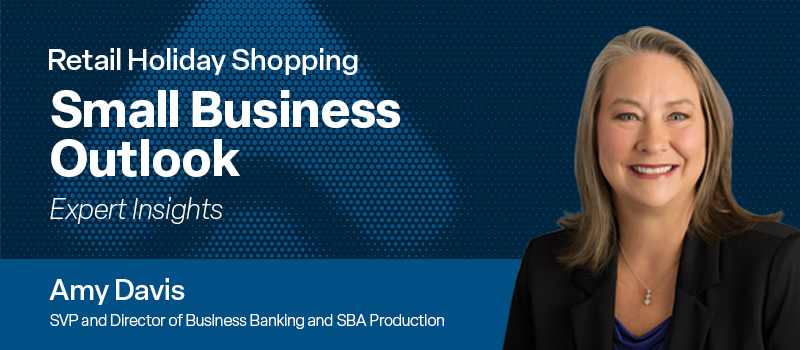
Amy Davis, SVP, Director of Business Banking and SBA Production
While Thanksgiving weekend remains the unofficial start of the holiday shopping season with Black Friday and Small Business Saturday, October has become somewhat of an early kickoff. Despite a slowdown in overall retail sales growth, core retail sales – excluding sales of volatile categories – rose 0.6% in October according to the latest Labor Department data. This underlying momentum is an encouraging signal for small business retailers heading into the holiday season, even as they continue to navigate broader economic uncertainty.
In this Q&A, Amy Davis discusses what Columbia Bank is hearing from business clients in the retail sector about consumer demand, why many remain focused on growth despite continued uncertainty, and how that growth appetite is showing up in SBA lending demand.
Q: What are you hearing from small business retailers about consumer demand as we head into the holiday season and year-end?
The sentiment we’ve been hearing throughout the year is that the pullback many businesses anticipated hasn't materialized to the degree that they expected. As we head into the holidays, many of the retail businesses we work with are seeing greater consumer demand and activity than they expected earlier in the year. At the same time, they still must balance that resilience against increasing cost pressures, which makes this a complicated environment to navigate.
Retailers have remained deliberate about when and where they deploy capital, but the appetite for investment in growth is there, which is in line with what we heard in our 2026 Business Barometer. The majority of retail leaders (60%) said they would prioritize investments over cost-cutting and 70% said they would be likely to borrow to invest in expansion through mid-2027.
Q: How is this resilient consumer demand affecting retailers’ willingness to invest in growth despite continued economic uncertainty?
U.S. retailers entered the second half of 2026 facing plenty of reasons to be cautious, from tariffs and inflation to higher operating costs. But that caution hasn’t necessarily translated into a pullback in investment, as many businesses have taken more time to make strategic decisions. Our Business Barometer, fielded in April-May, found that 67% of retail leaders were more likely to delay major decisions for at least six months as they monitor these cost pressures – more than the average across all sectors (59%).
Six months later, that growth outlook is consistent with what we're seeing more broadly in strong SBA loan demand. We started seeing a rebound in SBA approvals coming out of the summer and that momentum has continued into the fall. Columbia Bank approved 53 SBA loans in October 2026, totaling $12.7 million across our eight-state footprint. This represents a 41% year-over-year increase in SBA loan dollar volume compared to October 2025.
Q: Where does it make the most sense for retailers to put capital to work now, and where should they remain cautious?
Retailers should continue investing in areas where they see opportunities to position their business for long-term growth, while maintaining enough flexibility to pivot as consumer demand and cost pressures change. You don’t want uncertainty to prevent you from moving forward, but you also don’t want to become so committed to one strategy that you can’t adjust if conditions shift.
That’s why I always tell clients it’s important to discuss growth plans and financing options with your banking partner early. Even if you don’t need capital today, understanding the options available can help you make more informed decisions when an opportunity arises. A strong banking partner will understand where you want to take the business over the long term and help you evaluate the different paths to get there.
To learn more about Columbia Bank’s Business Banking and SBA lending options, click here.
